GEOTECHNICAL ENGINEERING
CELBRIDGE
HomeLaboratoryLaboratory CBR test

Laboratory CBR Testing in Celbridge: Pavement Design Assurance

Practical geotechnics, field-tested.

LEARN MORE

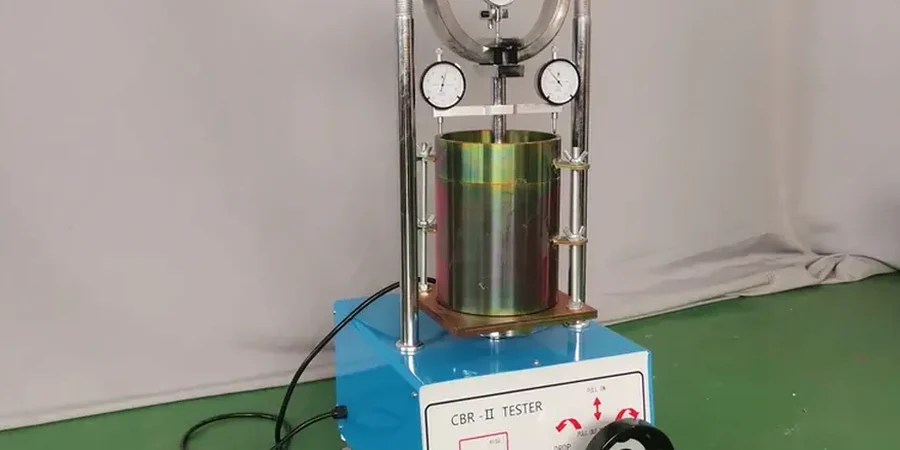
Celbridge sits on the Carboniferous limestone plains of County Kildare, with overlying glacial tills and alluvial deposits along the Liffey Valley. These subgrades range from stiff boulder clays to soft silty pockets within a few hundred metres. For anyone designing pavements, car parks, or access roads in Celbridge, the soaked laboratory CBR value is the direct input that determines the thickness of every layer above the formation. Without it, you are guessing. The local geology is not uniform, and a single site can present three different subgrade classes. Our laboratory near Celbridge runs the test under the conditions specified in the NRA HD 25/94 and the UK Specification for Highway Works, giving you a defensible design parameter. For projects where the near-surface material varies, we often complement the CBR programme with a grain-size analysis to confirm fines content before soaking begins.

A soaked CBR value below 2.5% on a Celbridge glacial till usually means a capping layer is mandatory before the sub-base goes in.
Our service areas

How we work

Celbridge grew rapidly during the late twentieth century, expanding from a village centred around Castletown House into a commuter town with extensive residential estates and link roads. That growth meant developers repeatedly encountered the same challenge: a thin crust of desiccated clay over a wet, sensitive subgrade that loses strength fast when saturated. The laboratory CBR test quantifies exactly that loss. A sample compacted at natural moisture content might read 12% CBR. The same material after four days soaking under a surcharge of 4.5 kg can drop below 2%. That difference is the cost of a pavement failure. We run the test in a controlled environment, monitoring swell during soaking and measuring penetration resistance with a calibrated proving ring. For sites near the R403 or the new link roads, where traffic loading is high, the soaked CBR is non-negotiable. We also cross-check the results with an Atterberg limits test when the plasticity index is suspected to influence the swell behaviour.
Laboratory CBR Testing in Celbridge: Pavement Design Assurance
Technical reference — Celbridge

Site-specific factors

A common mistake on smaller developments in Celbridge is relying on a single CBR value taken from a window sampler bag sample, tested unsoaked, and applying it across the entire site. That approach fails because the test was never designed for disturbed material. The laboratory CBR requires a sample compacted to a target density, and the soaking phase simulates the worst-case groundwater condition—which, given the high water table in the Liffey floodplain, is the condition that will govern the pavement life. Skipping the soak produces an artificially high CBR. The pavement then goes in thinner than it should. Two years later, the asphalt cracks along the wheel paths and the client is looking at a six-figure repair. For Celbridge sites with variable ground, we recommend a programme of at least three soaked CBRs, backed by a sand-cone density test to confirm the compaction assumptions used in the lab.

Need a geotechnical assessment?

Reply within 24h.

Email: contact@geotechnical-engineering.co

Regulatory framework

I.S. EN 13286-47:2012, BS 1377-4:1990, NRA HD 25/94 (now TII Publication)

Reference parameters

ParameterTypical value
Test standardBS 1377: Part 4: 1990, I.S. EN 13286-47
Sample preparationCompacted at optimum moisture content (Proctor reference) or at natural moisture content as specified
Soaking period96 hours under 4.5 kg surcharge, with swell measurement at 24-hour intervals
Penetration rate1.27 mm/min (±0.15 mm/min)
Key outputsCBR at 2.5 mm and 5.0 mm penetration, swell percentage, moisture content before and after soaking
Mould dimensionsCBR mould: 152 mm diameter, 127 mm height, with collar and base plate
Typical Celbridge subgradeGlacial till: 3-8% CBR (soaked), Alluvial silt: 1-4% CBR (soaked)

Frequently asked questions

How much does a laboratory CBR test cost in Celbridge?

A single soaked CBR test, including compaction and swell monitoring, typically ranges from €110 to €210. The cost depends on whether we are testing one point or running a programme of three or more samples. Most Celbridge projects require at least three points to capture subgrade variability.

How long does the test take?

The full soaked CBR test takes a minimum of five working days. This includes sample compaction, four days of soaking with daily swell readings, and the penetration test on the final day. Unsoaked tests can be completed in one to two days.

Why is soaking necessary for a Celbridge site?

The glacial tills and alluvial silts along the Liffey valley have a high water table that rises significantly in winter. The 96-hour soak simulates the saturated condition that the subgrade will experience in service. An unsoaked CBR overestimates strength and leads to under-designed pavements.

What sample size do you need?

We need about 5 to 6 kg of material passing a 20 mm sieve for each CBR mould. If the material is granular, a larger bulk sample of 25-30 kg may be required to obtain enough material for compaction at the correct moisture content.

Can you test material from a trial pit in Celbridge?

Yes. Disturbed samples from a trial pit are suitable provided they are representative of the formation level. We recommend taking the sample from the top 300 mm of the subgrade. If the material is below the water table, we need it sealed in a bag immediately to preserve the natural moisture content.

Location and service area

We serve projects across Celbridge and surrounding areas.

View larger map