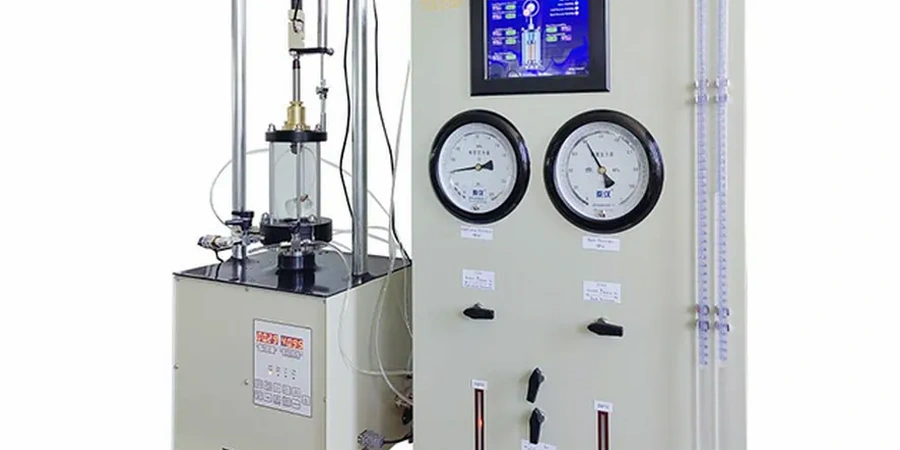
In Celbridge and across County Kildare, comprehensive geotechnical laboratory testing forms the foundation of safe and economical civil engineering design. A professional laboratory programme encompasses the physical classification and mechanical assessment of soils and rocks recovered from site investigations. These controlled tests move beyond visual descriptions to deliver quantified parameters — particle size distribution, plasticity characteristics, shear strength, compressibility, and chemical aggressivity — that engineers rely on for foundation design, earthworks specification, and groundwater control. Without this data, assumptions replace evidence, increasing both risk and construction cost.
Celbridge sits predominantly on glacial till and fluvioglacial deposits overlying Carboniferous limestone bedrock. The till is typically a firm to stiff sandy silty clay with varying cobble and boulder content, while the limestone can exhibit solution features and variable rockhead depths. These ground conditions demand careful laboratory characterisation. A grain size analysis (sieve + hydrometer) quantifies the fines content that governs drainage behaviour and frost susceptibility, while Atterberg limits define the plasticity range critical for assessing volume change potential in the cohesive tills. Understanding whether a soil is well-graded or gap-graded directly influences compaction specifications and subgrade performance.
All laboratory testing in Ireland must comply with the national standards framework. IS EN ISO 17892 governs the geotechnical laboratory testing of soils, harmonised with the Eurocode 7 design philosophy. Supporting documents include the Specification and Related Documents for Ground Investigations in Ireland (SR 50), published by Engineers Ireland, which sets mandatory schedules for laboratory accreditation. Testing houses operating near Celbridge are typically accredited by the Irish National Accreditation Board (INAB) to ISO 17025, ensuring traceability and competence in methods such as moisture content determination, triaxial compression, and oedometer consolidation.
A wide spectrum of projects in the Celbridge area depends on robust laboratory data. Residential schemes on greenfield sites require classification and compaction tests for road subgrades and soakaway design. Commercial developments on the town's brownfield parcels need chemical analysis for contamination and concrete aggressivity. Infrastructure projects — from the M4 widening to school extensions and wastewater treatment upgrades — cannot proceed without certified shear strength and consolidation parameters. Even single-house builds on marginal ground benefit from a targeted suite of grain size analysis (sieve + hydrometer) and Atterberg limits to validate foundation bearing assumptions and confirm suitability of on-site material for re-use as engineered fill.
A standard suite includes moisture content, bulk density, particle size distribution (sieve and hydrometer), and Atterberg limits for soil classification. Depending on the project, shear strength tests (triaxial or direct shear), oedometer consolidation, and chemical tests for pH, sulphate, and organic content are added. The exact schedule follows the recommendations of IS EN ISO 17892 and the guidance in Engineers Ireland's SR 50 document.
Visual logging provides qualitative information, but design requires quantified parameters. Laboratory tests measure exact values for strength, compressibility, and permeability that cannot be reliably estimated by eye. These values feed directly into geotechnical calculations for bearing capacity, settlement prediction, and slope stability. Regulatory submissions and warranty providers in Ireland also mandate certified laboratory results as a condition of approval.
Irish practice follows Eurocode 7 (IS EN 1997-2) which specifies that laboratory tests must comply with IS EN ISO 17892 standards. Additionally, Engineers Ireland's SR 50 document outlines mandatory testing schedules and requires that laboratories hold INAB accreditation to ISO 17025. These standards ensure consistent, internationally recognised procedures are used for all tests, from basic classification through to advanced triaxial testing.
A laboratory serving Celbridge projects should be accredited by the Irish National Accreditation Board (INAB) to ISO 17025. This accreditation confirms technical competence and requires regular proficiency testing and audits. Most public-sector contracts and large private developments in Kildare explicitly require INAB-accredited testing. The accreditation scope should cover the specific test methods listed in the ground investigation specification.
We serve projects across Celbridge and surrounding areas. More info.