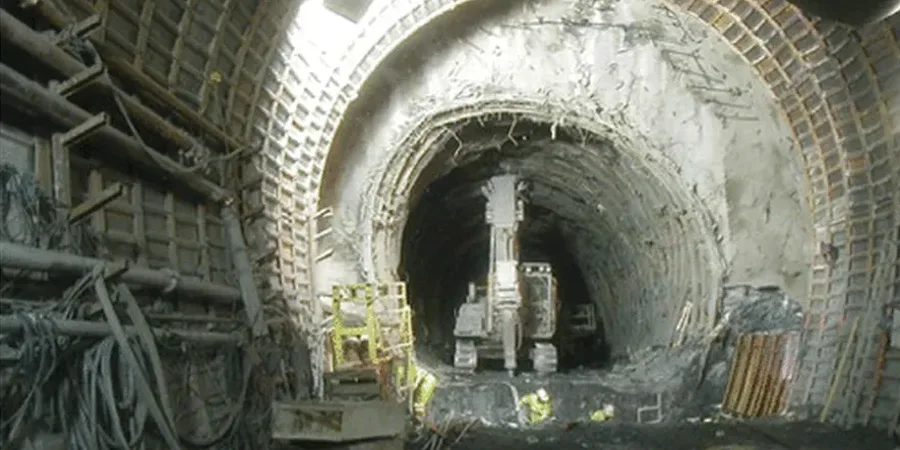
Tunnelling through the soft alluvial deposits of the River Liffey valley demands rigorous geotechnical control. Celbridge sits on a complex sequence of river terrace gravels, glaciolacustrine silts, and occasional peat lenses — materials that deform under very low confining pressure. Eurocode 7 (I.S. EN 1997-2:2007) requires a design based on reliable ground parameters, and nowhere is that more critical than in Celbridge, where the water table often lies within two metres of the surface. Mischaracterise the undrained shear strength of a silt lens, and you risk face collapse during excavation. Our laboratory performs triaxial and oedometer testing under INAB-accredited procedures to feed calibrated constitutive models. For the contractor, that means a tunnel support class specified with confidence. When the alignment crosses under the historic village core, we recommend coupling the ground investigation with a deep excavation monitoring programme to protect adjacent masonry structures from settlement-induced cracking.
In Celbridge's glaciolacustrine silts, small-strain stiffness can degrade by over 60% within the first 0.1% of shear strain — a non-linearity that standard SPT correlations completely miss.