GEOTECHNICAL ENGINEERING
CELBRIDGE
HomeGround improvementVibrocompaction design

Vibrocompaction Design in Celbridge: Ground Improvement for River Terrace Soils

Practical geotechnics, field-tested.

LEARN MORE

The ground conditions shift noticeably as you move from the historic centre of Celbridge, near Castletown House, down towards the newer developments along the Hazelhatch Road. At the higher elevations you encounter stiff glacial till, but closer to the River Liffey the profile changes to loose alluvial sands and silts—deposits that can extend 4 to 6 metres deep. For any structure transferring heavy loads into these terrace gravels, a vibrocompaction design tailored to the specific grain-size distribution is the first line of defence against differential settlement. We routinely pair this with CPT testing before and after treatment to quantify the improvement in cone resistance, ensuring the design assumptions hold once the vibrator comes off site.

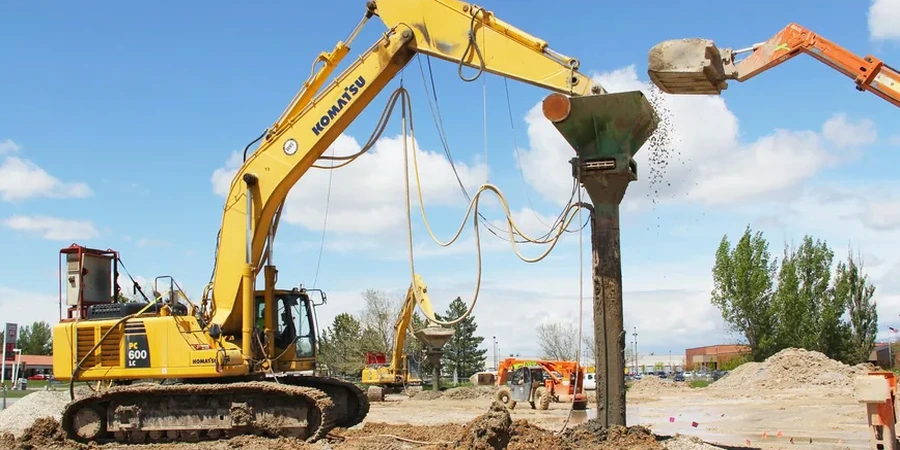
Effective vibrocompaction design in alluvial sands requires matching probe frequency, spacing, and duration to the grain-size curve—not applying a catalogue grid.
Our service areas

How we work

A frequent mistake we observe on sites west of the M4 is specifying a grid spacing copied from a project on Dublin Boulder Clay. Celbridge’s Liffey sands have a fines content that can exceed 15% in lenses, which drastically alters the compaction radius. Using a standard 3-metre triangular grid without verification leads to untreated columns of soil that will collapse the moment the water table rises. Our design process starts with sieve analysis from rotary wash borings, then calculates the required probe spacing and vibration duration per point. In zones where the silt fraction is too high for pure vibrocompaction, we integrate stone columns as a hybrid solution—installing granular drains that densify the matrix while providing a drainage path. The design also accounts for the proximity of the Rye Water, where seasonal fluctuations in groundwater demand a conservative approach to target relative density, typically 75% or higher under footing influence zones.
Vibrocompaction Design in Celbridge: Ground Improvement for River Terrace Soils
Technical reference — Celbridge

Site-specific factors

The microclimate of the Liffey Valley introduces a risk that drier inland sites don’t face: prolonged wet winters saturate the upper sand layer, reducing effective stress at the moment compaction energy is applied. If the design doesn’t account for this near-surface saturation, the probe can displace soil laterally rather than densifying it. We’ve seen cases in Celbridge where untreated loose sands, just 3 metres below ground, lost bearing capacity during a single season of high river levels. A vibrocompaction design that specifies pre-wetting or, conversely, a brief dewatering phase depending on the month of execution, makes the difference between a subgrade that gains strength with time and one that progressively loosens. The design must also address vibration monitoring near protected structures like Castletown House, setting peak particle velocity limits per BS 7385 to avoid cosmetic damage to heritage masonry.

Need a geotechnical assessment?

Reply within 24h.

Email: contact@geotechnical-engineering.co

Regulatory framework

BS EN 14731:2005 (Execution of special geotechnical work – Ground treatment by deep vibration), IS EN ISO 22476-1 (CPT verification for compaction control), BS 7385-2 (Vibration monitoring near buildings)

Reference parameters

ParameterTypical value
Applicable soil types (D50)Clean sands to silty sands, D50 > 0.2 mm
Maximum treatment depthUp to 20 m with leader-mounted vibrator
Typical grid patternTriangular, 2.0–3.5 m spacing (verified by CPT)
Target relative densityDr > 70%–80% (75% minimum under footings)
Pre/post verification methodCPT (cone resistance qc increase > 2x)
Vibrator power range130–180 kW electric or hydraulic
Fines content limit< 20% passing 75 μm for effective compaction

Frequently asked questions

What is the typical cost of a vibrocompaction design in Celbridge?

A complete design package—including ground investigation review, grid calculation, trial zone specification, and CPT verification planning—ranges from €1,400 to €4,800 depending on site area and complexity. Sites with high fines variability or proximity to the Rye Water require additional lab testing, which falls at the upper end of that bracket.

How do you verify that the vibrocompaction has worked?

We use pre- and post-treatment CPT soundings placed on the same grid nodes. The acceptance criterion is typically a minimum doubling of cone resistance qc in the target layer, or achieving a relative density above 75%. For larger sites we also run a limited number of SPT tests to correlate with the CPT data.

Can vibrocompaction be used near the protected structures in Celbridge?

Yes, but the design must include a vibration impact assessment with peak particle velocity limits. We set monitoring points at the nearest sensitive structure and keep PPV below 5 mm/s for heritage masonry, adjusting probe frequency or switching to a variable moment vibrator if readings approach the threshold.

What ground conditions in Celbridge rule out vibrocompaction alone?

When the fines content exceeds 20% or the soil classifies as a silt rather than a silty sand, pure vibrocompaction becomes ineffective. In those lenses we transition to a vibro-replacement design using stone columns, which provide both densification and drainage without relying on grain-to-grain contact for compaction.

Location and service area

We serve projects across Celbridge and surrounding areas.

View larger map