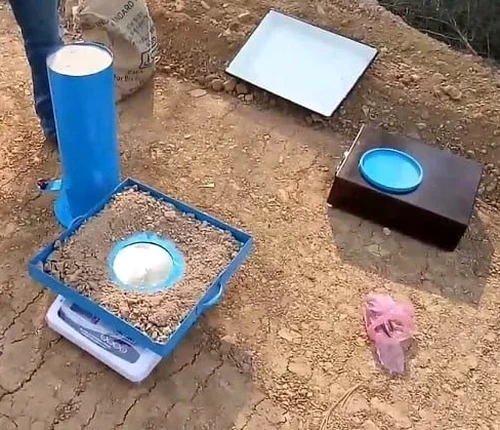
A rolled fill in Celbridge that hasn't been properly density-tested can settle months after handover, cracking pavement and damaging kerbs. We have seen it happen on sites near the Liffey where the underlying gravels gave a false sense of security. The sand cone test remains the most direct way to verify compaction in the field: you excavate a small hole, measure its volume with calibrated sand, and compare the in-place dry density against the laboratory maximum from a Proctor curve. In Celbridge, where the subsoil shifts between the well-drained limestone tills of the Donore area and the softer alluvial silts along the R403 corridor, a single Proctor reference without site-specific verification rarely tells the full story. We run the test to ASTM D1556 / D1557, pairing it with a Proctor curve determined from material sampled at the same lift, so the compaction percentage you get reflects actual site conditions and not a generic lab benchmark.
A sand cone test is only as reliable as the calibration that precedes it — skip the morning sand-weight check and the whole day's results are suspect.